
Looking for names that mean change for a baby, fictional character, creative project, or a fresh chapter in life? The right name can suggest transformation, resilience, growth, renewal, or the courage to begin again.
But there is an important difference between a name that literally means change and one that symbolizes it. Very few established personal names translate directly to the English word “change.” Others have documented meanings such as new, born again, growth, dawn, or hope.
This guide explores 45 inspiring names related to change, with their linguistic origins and the specific connections that make them relevant. Some are familiar given names, others are uncommon, and a few are symbolic or experimental choices best suited to creative writing.
Quick answer: Devrim means “revolution” in Turkish. Arata can mean “new” in Japanese, while Renata belongs to a Latin name family meaning “born again.” Zora means “dawn,” and Phoenix is associated with rebirth through mythology rather than through its literal word meaning.
Table of Contents
Names Closest to the Meaning of Change or Transformation
Some names directly express a major change, while others refer to cycles or mythological transformations.
The following five choices are especially relevant, but their meanings are not interchangeable.
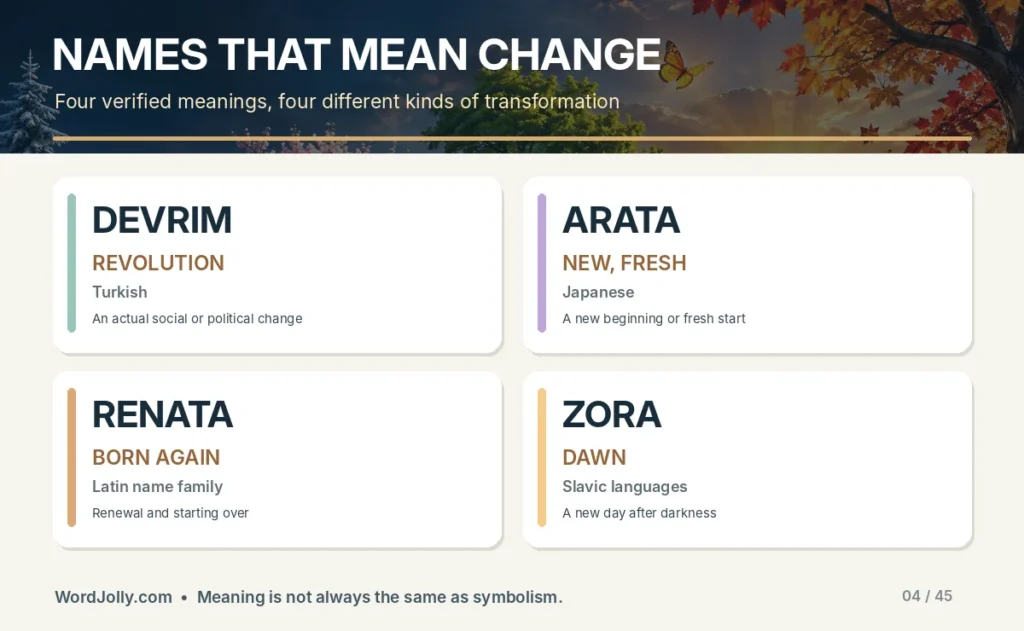
1. Devrim: Revolution
Origin: Turkish
Traditional usage: Masculine
Devrim is an established Turkish name meaning “revolution.”
It is one of the strongest documented choices for someone looking for a name expressing a significant transformation.
Revolution suggests a fundamental shift in society or an established order, so it is more specific than the general English word “change.”
For fiction, Devrim could suit a reformer, visionary, or someone whose decisions reshape an entire community.
2. Kaizen: Improvement or Change for the Better
Origin: Japanese word
Usage: Uncommon, modern word-name suggestion
Kaizen is associated with the Japanese concept of improvement, often described as continuous improvement.
The term combines elements related to change and improvement.
It is not a conventional Japanese given name in the same sense as Arata. It is better treated as an unusual word-name option, particularly for fiction.
Kaizen could symbolize a person who values steady progress rather than sudden transformation.
3. Samsara: The Cycle of Existence
Origin: Sanskrit
Usage: Philosophical and religious term; occasionally adapted as a name
Samsara refers to the cycle of birth, death, and rebirth in several Indian religious traditions.
The word does not literally mean change. Its connection comes through repeated existence and the concept of cyclical transformation.
Because Samsara carries important religious and philosophical meaning, it deserves thoughtful treatment rather than being presented as an ordinary invented fantasy word.
It could be appropriate in a story that explores time, identity, spiritual development, or the repetition of history.
4. Phoenix: Rebirth Through Mythology
Origin: Greek mythological bird name
Usage: Modern English unisex given name
Phoenix is associated with a legendary bird that rises from its ashes after destruction.
Its historical Greek word origin is connected with the color dark red, not a direct translation of change or rebirth.
Nevertheless, the myth makes Phoenix one of the most recognizable symbolic names for renewal.
It is particularly fitting for a character who survives hardship and creates a new life.
5. Proteus: A Shape-Shifting Figure
Origin: Greek mythology
Usage: Mythological masculine name
Proteus is a prophetic sea god remembered for his ability to change shape.
His name comes from a Greek word meaning “first,” rather than “change.”
The transformation connection is therefore mythological, not etymological.
Proteus is an interesting choice for fantasy characters whose identities, appearances, or loyalties change throughout a story.
14 Names That Mean New or Fresh Beginnings
A new beginning is a natural way to express change.
The following established names are connected to newness, freshness, or the beginning of another cycle.
6. Arata: New or Fresh
Origin: Japanese
When written with the Japanese character 新, Arata means “new” or “fresh.”
Other characters and combinations can produce the same pronunciation with different meanings.
Arata is especially suitable for a character beginning a new life or someone whose story centers on renewal.
7. Navin: New or Fresh
Origin: Sanskrit, used in several Indian languages
Navin derives from a Sanskrit element meaning “new” or “fresh.”
It is a clear choice for a name associated with a fresh beginning.
Its meaning is about newness rather than the process of transformation itself.
8. Naveen: New or Fresh
Origin: Indian-language variant of Navin
Naveen is an alternate transcription of the same name represented by Navin.
It therefore shares the underlying meaning of newness.
This is a spelling alternative, not an unrelated etymological origin. It is useful for readers choosing between familiar written forms.
9. Abhinav: Young or Fresh
Origin: Sanskrit
Abhinav derives from a Sanskrit word meaning “young” or “fresh.”
It offers a connection to renewed energy and a modern start.
Although it does not directly translate as transformation, its documented meaning fits stories about new opportunities.
10. Apurva: Unprecedented or New
Origin: Sanskrit
Apurva comes from a Sanskrit word meaning “unprecedented” or “new.”
It is used as a given name in India, with masculine and feminine forms represented in transliteration.
The meaning suits someone associated with an entirely new experience, direction, or possibility.
11. Nova: New
Origin: Latin-derived modern name
Nova comes from Latin novus, meaning “new.”
Its short, memorable sound has made it a recognizable modern name.
Nova is a strong choice for anyone who wants a direct linguistic connection with newness.
It can also evoke astronomical imagery, although its etymological meaning remains separate from the symbolism of change.
12. Neo: New in Its Greek-Derived Usage
Origin: Greek-derived modern usage
In one naming tradition, Neo comes from a prefix ultimately derived from Greek neos, meaning “new.”
However, Neo also exists independently as a Tswana name meaning “gift.”
These are distinct name histories and should not be confused.
The Greek-derived interpretation makes Neo a suitable modern option for a new beginning.
13. Neon: New
Origin: Ancient Greek
Neon is an ancient Greek masculine name derived from the word neos, meaning “new.”
Although modern English speakers may associate Neon with bright signs and the chemical element, the historical name has its own Greek origin.
It is a more unusual choice for a fictional character or a modern naming shortlist.
14. Novella: New or Young
Origin: Italian, ultimately Latin
Novella derives from Latin novellus, meaning “new,” “young,” or “novel.”
It has a documented history as a personal name.
Its elegant sound makes it a distinctive alternative to Nova for someone attracted to the theme of new beginnings.
15. Novak: New
Origin: Serbian
As a masculine given name, Novak derives from the Serbian word for “new.”
It also has a separate history as a surname associated with a newcomer to a settlement.
Novak is particularly useful in realistic fiction because it is an established personal name rather than a creative invention.
16. Dagny: New Day
Origin: Old Norse
Dagny derives from elements meaning “day” and “new.”
Together, they express the idea of a new day.
Dagny is a strong poetic choice for a fresh chapter, especially when the story emphasizes resilience after difficulty.
17. Hodesh: New Moon or Month
Origin: Biblical Hebrew
Hodesh is an attested biblical feminine name meaning “new moon” or “month.”
The new moon is the beginning of another lunar cycle, making the name symbolically relevant to renewal.
This is a historical name, though its meaning is not identical to the English word change.
18. Navdeep: New Light
Origin: Sanskrit-derived, used in Sikh naming traditions
Navdeep combines elements meaning “new” or “fresh” and “lamp” or “light.”
The name has a beautiful symbolic connection to a new source of illumination.
It is an especially meaningful choice for someone seeking a name associated with new opportunities or guidance.
19. Xin: New in One Chinese Character Form
Origin: Chinese
Xin can be written with several Chinese characters, each carrying its own meaning.
When written 新, it means “new” or “fresh.”
Other characters pronounced Xin can express different ideas, including prosperity or joy.
If choosing this name for its meaning, the actual written character matters.
8 Names That Mean Reborn, Resurrection, or Renewal
Rebirth is a particularly powerful form of transformation.
The following names have connections to being born again or rising again.
Some share the same linguistic root, while others come from separate languages.
20. Renatus: Born Again
Origin: Late Roman Latin
Renatus is a Latin masculine name meaning “born again.”
It is one of the clearest examples of a historical name associated with renewal.
The phrase can have religious significance, but it can also function symbolically in fiction as a second chance.
21. Renata: Born Again
Origin: Latin name family
Renata is the feminine form of Renatus.
It carries the same fundamental meaning, “born again.”
Used in several European languages, Renata offers a graceful established choice for a theme of personal renewal.
22. René: Born Again
Origin: French form of Renatus
René is a French masculine form of the Latin name Renatus.
Its meaning is inherited from the original Latin name rather than independently coined.
The name may appeal to readers seeking a familiar European name associated with renewal.
23. Renée: Born Again
Origin: French feminine form
Renée is the French feminine counterpart of René.
It belongs to the same Latin-derived name family meaning “born again.”
The accent is part of its standard French spelling.
Renée can symbolize rebuilding, rediscovery, or starting a new chapter in life.
24. Anastasia: Connected to Resurrection
Origin: Greek
Anastasia is the feminine form of Anastasius, a name derived from a Greek word meaning “resurrection.”
It is strongly associated with renewal and rising again.
Its meaning is better explained as resurrection rather than simply “change.”
25. Anastasios: Resurrection
Origin: Greek
Anastasios is the Greek masculine form of the name represented in Latin as Anastasius.
Its origin is connected to the Greek word for resurrection.
This makes it an established choice for a story focused on recovery, survival, or renewal.
26. Harutyun: Resurrection
Origin: Armenian
Harutyun is an Armenian masculine name meaning “resurrection.”
It provides a documented alternative to the Greek and Latin name families above.
For someone researching genuine names related to rising again, Harutyun is an especially relevant option.
27. Resurrección: Resurrection
Origin: Spanish
Resurrección is a Spanish feminine name meaning “resurrection.”
The name has strong Christian religious associations.
It is an example of a historical personal name that directly expresses the concept of rising again, rather than a metaphor invented for a modern name list.
8 Names That Mean Growth, Progress, or Blooming
Not every change happens suddenly.
Sometimes transformation is gradual, like a flower opening or a person developing over time.
These eight names offer documented connections to growth and flourishing.
28. Zayd: Growth
Origin: Arabic
Zayd means “growth” and comes from an Arabic root connected with growing or increasing.
It is a concise established masculine name with a direct association with development.
29. Ziyad: Growth or Increase
Origin: Arabic
Ziyad means “growth,” “increase,” or “excess.”
It comes from the same broad Arabic root family as Zayd.
Although the two names are related, their forms and conventional translations differ.
30. Gudina: Growth or Advancement
Origin: Oromo
Gudina is a masculine name meaning “growth” or “advancement” in Oromo.
Its meaning makes it particularly relevant for someone seeking a name about progress.
It offers a less familiar but documented cultural example beyond common European name lists.
31. Wattana: Development or Prosperity
Origin: Thai
Wattana is associated with development, prosperity, and growth in Thai.
It is ultimately connected to a Sanskrit word family.
The name is fitting for a theme of personal progress, achievement, or improving circumstances.
32. Chloe: Green Shoot
Origin: Greek
Chloe means “green shoot” in Greek, referring to new plant growth.
The name has historical associations with the goddess Demeter and spring vegetation.
Its connection to change is botanical: fresh growth after a dormant season.
33. Nitzan: Flower Bud
Origin: Hebrew
Nitzan means “flower bud” in Hebrew.
A bud represents a plant before it opens, making the name a gentle symbol of possibility and development.
The name is suitable for those who prefer quiet growth over dramatic transformation.
34. Florian: Connected to Flowers
Origin: Latin-derived European name
Florian comes from the Latin name Florianus, which is related to the Latin word family for flowers.
Its meaning and historical background make it suitable for themes of flourishing and natural beauty.
It does not directly translate to change.
35. Flora: Flower
Origin: Latin
Flora derives from the Latin word for flower.
Flora was also the Roman goddess associated with flowers and spring.
The name suggests natural renewal, blooming, and the return of life after winter.
7 Beautiful Names Symbolizing Dawn and a New Season
Dawn and spring are familiar symbols of transformation.
The following names literally refer to morning light or springtime, not to change itself.
36. Aurora: Dawn
Origin: Latin
Aurora means “dawn” in Latin.
In Roman mythology, Aurora was the goddess of the morning.
It is a beautiful choice for a character or child associated with a new chapter or a hopeful beginning.
37. Zora: Dawn
Origin: Slavic languages
Zora means “dawn” in several Slavic languages.
The name is short, lyrical, and closely associated with the beginning of another day.
Its connection to transformation is symbolic rather than a literal translation of change.
38. Usha: Dawn
Origin: Sanskrit name tradition
Usha is related to Ushas, the Vedic personification of dawn.
It carries associations with morning light and the arrival of a new day.
The name works well for a theme of hope after uncertainty.
39. Alba: Associated With Dawn
Origin: Italian, Spanish, and other European traditions
Alba has multiple historical origins, including Latin and Germanic name families.
In Italian, Spanish, and Catalan, alba means “dawn,” which has influenced the modern interpretation and use of the name.
It should not be assumed that every historical bearer of Alba received the name through this meaning.
40. Vesna: Spring
Origin: Slavic languages
Vesna means “spring” in several Slavic languages.
It also has associations with a figure or spirit of spring in Slavic mythology.
The name symbolizes the seasonal transformation from winter to warmer, greener months.
41. Aviv: Spring
Origin: Hebrew
Aviv means “spring” in Hebrew.
It is used as a masculine and feminine given name.
The meaning makes Aviv a natural choice for renewal, youth, and fresh growth.
42. Sepideh: Dawn or First Light
Origin: Persian
Sepideh means “dawn” or “first light” in Persian.
It is an elegant example of a name with a clearly documented connection to the beginning of the day.
The symbolism is especially appealing for a character emerging from a difficult period.
3 Names That Represent Hope After Change
Change can be frightening, but it can also bring possibility.
These final three names do not mean change. Instead, their documented meanings represent hope for what comes next.
43. Hope: Hope
Origin: English
Hope is an English virtue name derived from the ordinary word.
It became established as a personal name through historical religious naming traditions.
For a story about starting again, Hope expresses the emotional purpose of transformation rather than the transformation itself.
44. Esperanza: Hope
Origin: Spanish
Esperanza is a Spanish name connected to the Latin word family for hope.
Its meaning is a direct expression of optimism and expectation.
It is particularly fitting for a character whose journey moves from uncertainty toward renewed possibility.
45. Elpis: Hope
Origin: Ancient Greek
Elpis means “hope” in Greek.
In Greek mythology, Elpis was also the personification of hope.
This makes it an especially relevant mythological name for a story where change ultimately leads to a better future.
How to Choose Names That Mean Change
A meaningful name should suit its intended use as well as its linguistic origin.
Decide What Kind of Change You Want to Express
Are you describing a major revolution, a fresh start, gradual personal growth, or the possibility of rebirth?
For significant upheaval, Devrim is a relevant choice.
For newness, consider Arata, Navin, or Nova.
For being born again, Renatus and Renata offer direct historical connections.
For gentle renewal, Zora, Chloe, or Vesna may be more appropriate.
Match the Name to the Character or Person
A fictional character who undergoes a dramatic transformation might suit Phoenix because of its mythology.
A realistic contemporary character may be better served by an established name such as Renata or Aurora.
If naming a real child, consider family preferences, cultural significance, pronunciation, spelling, and how the person may feel about the name as an adult.
Verify the Original Meaning
Names often have more than one origin.
For example, Neo has distinct meanings in Greek-derived and Tswana usage.
Xin depends on the Chinese character used.
Alba has multiple historical name origins, while its association with dawn is especially relevant in several Romance languages.
Do not assume that similar-sounding names share the same meaning.
Be Careful With Mythological and Religious Names
Samsara, Proteus, Phoenix, and Resurrección have cultural, religious, or mythological associations that deserve consideration.
A name used respectfully in one story may feel inappropriate in another context.
The background of a name can matter as much as its English-language interpretation.
Which Names Are Best for Different Purposes?
For girls: Renata, Renée, Anastasia, Nova, Aurora, Chloe, Zora, Vesna, and Sepideh offer different kinds of renewal symbolism.
For boys: Devrim, Arata, Navin, Renatus, Novak, Zayd, Gudina, and Anastasios offer documented connections to transformation, newness, rebirth, or growth.
For gender-neutral choices: Aviv, Navdeep, Xin, and Phoenix are worth considering, with cultural usage and spelling taken into account.
For fantasy characters: Phoenix, Proteus, Elpis, Neon, and Hodesh can provide distinctive imagery and themes.
For a story about starting over: Renata, Dagny, Nova, Zora, and Hope are especially expressive.
For a darker story involving separation and rediscovery, WordJolly’s Names That Mean Lost guide offers a different perspective on identity and change.
If you are creating an entire fantasy world for these characters, explore our Fictional Country Names for location and worldbuilding ideas.
Frequently Asked Questions About Names That Mean Change
What name literally means change?
There are relatively few widely established given names that directly translate to the general English word “change.” Devrim means “revolution” in Turkish, while Kaizen is a Japanese concept associated with improvement and change for the better. Kaizen is better treated as an unconventional word-name suggestion rather than a common traditional given name.
What girl name means new beginning?
Nova means “new,” while Renata belongs to a Latin name family meaning “born again.” Aurora means “dawn,” making it a symbolic choice for a fresh beginning.
What boy name means transformation?
Devrim, meaning “revolution,” is a strong choice for significant change. Arata can mean “new” in Japanese, and Renatus means “born again” in Latin. Each expresses a different aspect of transformation.
What name means reborn?
Renatus literally means “born again.” Renata, René, and Renée belong to the same name family. Anastasia and Anastasios are instead connected to the Greek concept of resurrection.
Does Phoenix literally mean rebirth?
No. Phoenix is associated with rebirth because of the mythological bird that rises from its ashes. The underlying Greek word has a historical meaning associated with dark red.
What Japanese name means change?
Arata can mean “new” or “fresh” when written with the relevant Japanese character. Kaizen is a Japanese term for improvement and is sometimes used creatively as a name idea, but it should not be presented as a common traditional personal name.
What name represents personal growth?
Zayd means “growth” in Arabic. Gudina means “growth” or “advancement” in Oromo, while Wattana is connected with development and prosperity in Thai.
Which name is best for a character who starts a new life?
Phoenix is a dramatic symbolic option, while Renata, Nova, and Arata have documented meanings associated with rebirth or newness. The best choice depends on your setting, cultural context, and character’s story.
Final Thoughts
The most meaningful names that mean change are not always direct translations of the word.
Some, like Devrim, express revolution. Others, such as Arata and Nova, mean new or fresh. Renatus and Renata carry the idea of being born again, while Chloe, Zayd, and Gudina express growth.
Names such as Aurora, Zora, and Hope represent the possibility of a brighter future.
Whether you are choosing a name for a child, developing a fictional character, or creating a symbolic identity, understanding the real meaning makes the choice more personal and memorable.
Explore more carefully researched naming ideas in WordJolly’s Words & Meanings collection.
Name Meaning References
The principal linguistic references for this article are:
- Behind the Name: Devrim
- Behind the Name: Arata
- Behind the Name: Renatus
- Behind the Name: Aurora
- Behind the Name: Zayd
- Behind the Name: Names Related to New
- Nameberry: Names That Mean Change
Meanings were separated from symbolic, mythological, and unconventional word-name associations rather than presented as identical translations.