
Looking for names that mean rabbit for a baby, pet bunny, fictional character, or creative project? Rabbits are often associated with gentleness, agility, curiosity, springtime, and new beginnings. A rabbit-inspired name can be sweet, playful, mysterious, or surprisingly meaningful.
However, there is an important distinction: very few established personal names literally mean “rabbit.” Some names come from words for rabbits or hares in other languages. Others are surnames, mythological names, familiar fictional characters, or creative nicknames inspired by these animals.
This guide explores 50 rabbit-related naming ideas, separated into five groups: literal rabbit words and related names, documented rabbit surnames, famous fictional rabbits, cute pet names, and original fantasy suggestions.
Quick answer: Usagi means “rabbit” in Japanese, and Tochtli is a Nahuatl word meaning “rabbit.” Coelho is a Portuguese surname derived from the word for rabbit, while Hase is a German surname connected to the word for hare. For a cute pet rabbit, consider Clover, Mochi, Nibbles, or Snowball.
Table of Contents
8 Names and Words With Rabbit or Hare Meanings
These eight examples are connected to genuine rabbit-related vocabulary, naming traditions, or mythology.
Important: A word meaning “rabbit” in another language is not automatically a conventional personal name. Where evidence of everyday given-name usage is limited, that distinction is explained.
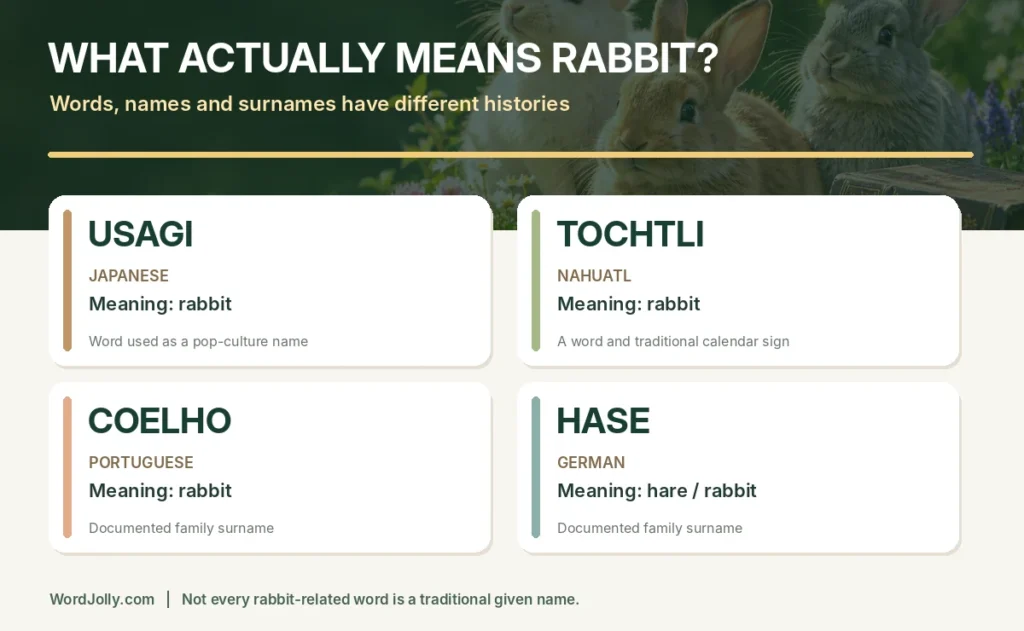
1. Usagi: Rabbit
Origin: Japanese
Meaning: Rabbit or hare
Usage: Japanese word; familiar as a popular-culture character name
Usagi is a Japanese word meaning “rabbit” or “hare.”
It is especially recognizable through Usagi Tsukino, the central character of Sailor Moon.
The connection is direct rather than metaphorical. However, Usagi should not be presented as a common traditional Japanese given name simply because it is familiar from fiction.
For a fictional character, mascot, or rabbit-themed creative project, Usagi has an appealing sound and an unmistakable meaning.
Source: Behind the Name: Usagi
2. Tochtli: Rabbit
Origin: Nahuatl
Meaning: Rabbit
Usage: Language word and traditional calendar sign
Tochtli is a Nahuatl word meaning “rabbit.”
It is also associated with the rabbit day sign in the traditional Aztec calendar system.
The name has cultural and historical significance beyond its animal meaning. It should therefore be treated as a word from a living Indigenous linguistic tradition, rather than an invented fantasy name.
Tochtli may interest writers researching Mesoamerican naming traditions, but its actual cultural context matters.
Source: Behind the Name: Submitted Rabbit-Related Names
3. Chandaga: Rabbit
Origin: Mongolian
Meaning: A type of hare or rabbit
Usage: Established vocabulary word; personal-name usage not independently established
Chandaga, written Чандага in Mongolian Cyrillic, is associated with a hare that changes color seasonally.
The word is documented in a Mongolian-language dictionary.
It appears in some user-submitted name lists, but that is not sufficient evidence that it is a widely used Mongolian personal name.
As a word, Chandaga is especially evocative for a story involving snow, wilderness, or animals.
Source: Mongolian explanatory dictionary: Чандага
4. Sungura: Rabbit or Hare
Origin: Swahili
Meaning: Rabbit or hare
Usage: Vocabulary word and folktale animal figure
Sungura is a Swahili word meaning “rabbit” or “hare.”
The rabbit is also associated with cleverness and trickery in East African animal stories.
Sungura is a meaningful choice for researching storytelling traditions involving rabbits. Its use as an everyday personal name, however, should not be assumed.
This example is especially interesting because the animal’s connection to quick thinking comes from folklore, not merely from its physical appearance.
Source: MobiTUKI Swahili Dictionary: Sungura
5. Thỏ: Rabbit
Origin: Vietnamese
Meaning: Rabbit or hare
Usage: Vietnamese word; occasionally suggested as a name
Thỏ is the Vietnamese word for rabbit or hare.
The accent mark is important to the word’s spelling and pronunciation.
Some naming lists suggest it as a personal name, but its appearance as a vocabulary word should not be confused with evidence of widespread given-name use.
For a fictional setting inspired by Vietnamese language or culture, the word should be handled with appropriate linguistic context.
6. Kani: Rabbit
Origin: Finnish
Meaning: Rabbit
Usage: Ordinary Finnish word; unconventional name idea
Kani means “rabbit” in Finnish.
The word is related to kaniini, another Finnish term for rabbit.
Kani may sound like a short, simple personal name to English-speaking readers, but its basic meaning in Finnish is the animal.
It is better described as a word-name possibility or pet nickname than as a well-established traditional given name.
Source: Institute for the Languages of Finland: Kani
7. Nanabozho: My Rabbit
Origin: Ojibwe
Meaning: Traditionally explained as “my rabbit”
Usage: Anishinaabe mythology
Nanabozho, also known through variant forms including Nanabush, is an important figure in Anishinaabe storytelling traditions.
Behind the Name connects the name to the Ojibwe word waabooz, meaning rabbit.
Nanabozho is a cultural and spiritual figure, not merely a cute bunny name.
It is included here to explain a genuine rabbit-related name from mythology, not as a casual recommendation for naming a pet or child.
Source: Behind the Name: Nanabozho
8. Shashanka: Hare-Marked, Associated With the Moon
Origin: Sanskrit
Meaning: Moon; literally interpreted as “hare-marked”
Usage: Masculine personal name in Sanskrit-derived naming traditions
Shashanka is connected to Sanskrit elements meaning “hare” and “mark” or “spot.”
The combined expression is used poetically for the moon, traditionally associated with the image of a hare visible on its surface.
Shashanka is therefore not a direct translation of the English word rabbit.
Instead, it is an example of a genuine personal name with an ancient hare-related interpretation.
It is a good choice for readers attracted to lunar mythology and poetic names.
Source: Behind the Name: Shashanka
8 Real Last Names That Mean Rabbit or Hare
Surnames sometimes preserve the names of animals through historical nicknames, occupations, house signs, and place names.
The following eight surnames have documented rabbit or hare associations.
They are real family names rather than invented names for pet rabbits.
9. Coelho: Rabbit
Origin: Portuguese
Coelho comes from the Portuguese word for rabbit.
Historically, it could have functioned as a nickname or described someone who hunted or sold rabbits.
It is a particularly clear example of a real surname with a rabbit-related meaning.
10. Coello: Rabbit
Origin: Galician
Coello is a Galician surname related to Portuguese Coelho.
It shares a linguistic connection with the word for rabbit.
The two surnames are related but belong to different language traditions.
11. Hase: Hare or Rabbit
Origin: German
Hase comes from historical German words meaning hare or rabbit.
It may originally have described someone who was swift, timid, or otherwise associated with the animal.
Hase is a strong example of a documented family name with an animal-based origin.
12. Haas: Hare
Origin: German, Dutch, and Ashkenazic Jewish surname traditions
Haas is related to words meaning “hare.”
Historical explanations include animal nicknames and names connected to houses identified by a hare sign.
Because it has several naming histories, the origin of an individual family’s surname should be researched separately.
13. Conejo: Rabbit
Origin: Spanish
Conejo comes from the Spanish word for rabbit.
Historically, it could be used as a nickname or an occupational name for a person associated with catching or trading rabbits.
Its rabbit connection is documented in surname dictionaries.
14. Lepore: Hare
Origin: Italian
Lepore comes from a southern Italian form of a word meaning “hare.”
It may have functioned as a nickname for someone regarded as quick-moving or timid.
Unlike Coelho or Conejo, its underlying word specifically means hare.
15. Lelièvre: The Hare
Origin: French
Lelièvre, also written Le Lièvre, is a French surname derived from an expression meaning “the hare.”
It could historically describe a fleet-footed person or serve as an animal nickname.
The surname is an excellent example of how animal names enter family-name traditions.
16. Hasenkamp: Rabbit Field
Origin: German
Hasenkamp comes from a northern German place name associated with a hare or rabbit field.
Its elements refer to the animal and a field or enclosed area.
Unlike the simpler Hase surname, Hasenkamp has a geographical component.
Surname research sources: Behind the Name: Rabbit-Related Surnames, FamilySearch: Conejo, FamilySearch: Haas, and FamilySearch: Lepore.
10 Famous Fictional Rabbit and Bunny Names
Not every rabbit-related name means rabbit linguistically.
Some ordinary given names become strongly associated with rabbits because they belong to famous fictional characters.
These ten names are included for literary and popular-culture inspiration, not because their original etymologies translate to rabbit.
17. Peter
Peter Rabbit is the central character of Beatrix Potter’s classic children’s story.
The name Peter has a Greek origin connected with the word for rock, not rabbit.
Its rabbit association comes from the fictional character.
18. Benjamin
Benjamin Bunny is another character from Beatrix Potter’s stories.
Benjamin is a Hebrew-derived personal name with a meaning unrelated to rabbits.
Its familiar use in children’s literature makes it a charming rabbit-inspired option.
19. Flopsy
Flopsy is one of Peter Rabbit’s sisters.
The name sounds soft and playful and is connected to the rabbit character rather than an established historical meaning of rabbit.
It works particularly well as a pet nickname.
20. Mopsy
Mopsy is another member of Peter Rabbit’s family.
Like Flopsy, it is memorable because of its literary association.
Its cheerful sound makes it a natural possibility for a playful bunny.
21. Cotton-tail
Cotton-tail is the name of Peter Rabbit’s other sister.
The name is associated with a rabbit’s short, fluffy tail.
For a real pet, a shorter version such as Cotton or Cottontail may be more convenient.
22. Thumper
Thumper is a rabbit character in Disney’s Bambi.
The name evokes the sound of a rabbit thumping its hind feet.
It is an expressive nickname for an energetic bunny, but it does not have a historical personal-name origin meaning rabbit.
23. Miffy
Miffy is the familiar little rabbit created by Dutch illustrator Dick Bruna.
The name is associated with the character’s gentle, simple appearance.
It is a sweet possibility for a small white rabbit or a fictional animal character.
24. Bugs
Bugs Bunny is one of the most recognizable animated rabbits.
The name is playful and immediately brings to mind a quick-witted cartoon character.
Its connection is entirely through popular culture.
25. Lola
Lola Bunny is a rabbit character associated with the Looney Tunes universe.
Lola is also a real given name with a separate linguistic history.
Its rabbit association comes from the animated character, not its original meaning.
26. Judy
Judy Hopps is the rabbit police officer in Disney’s Zootopia.
Judy is a familiar English diminutive related to Judith.
For rabbit-themed naming, it suggests determination and courage through the character rather than through its etymology.
12 Cute Rabbit Names Inspired by Nature and Personality
If you are naming a pet bunny, you may prefer a name that sounds affectionate rather than one with a literal translation.
The following suggestions are everyday words or familiar names associated with flowers, food, textures, or playful behavior.
None of these twelve names literally means rabbit.
27. Clover
A fresh, nature-inspired name for a gentle rabbit.
Clover is particularly appealing for a bunny that enjoys exploring grassy spaces.
28. Nibbles
A playful nickname inspired by the little nibbling movements associated with rabbits.
Nibbles is simple, memorable, and ideal for an energetic pet.
29. Snowball
An affectionate choice for a white, fluffy rabbit.
The name creates an immediate visual image and is easy to call aloud.
30. Mochi
Inspired by the soft Japanese rice cake.
Mochi is especially cute for a small, round, fluffy-looking bunny.
31. Thistle
A slightly unusual botanical name.
Thistle works well for an adventurous rabbit or a character living in the countryside.
32. Dandelion
A bright nature name associated with open fields and spring.
Dandelion is especially suitable for a cheerful, curious bunny.
33. Cotton
A simple name inspired by softness and fluffy textures.
Cotton is especially appropriate for a light-colored rabbit.
34. Poppy
A short floral name with a cheerful sound.
Poppy could suit an energetic rabbit that enjoys hopping around its environment.
35. Hazel
Hazel is an established English given name and the name of a tree.
It is also associated with a rabbit character in Watership Down, giving it a second rabbit-related connection through literature.
36. Pepper
A lively choice for a black, gray, or multicolored rabbit.
Pepper is short, easy to pronounce, and suited to an energetic personality.
37. Toffee
A warm, sweet name for a golden-brown bunny.
The word refers to a confection, not a rabbit, but its color association makes it appealing.
38. Juniper
An elegant botanical name inspired by the juniper plant.
Juniper is suitable for a gentle rabbit or a fictional character with a woodland theme.
12 Original Fantasy Names Inspired by Rabbits
For a fantasy novel, game, comic, or animal-character world, you can create entirely new rabbit-inspired names.
The following suggestions are invented English-style combinations. They are not documented traditional given names or verified translations.
They are original naming prompts, not promises that the names have never appeared elsewhere.
39. Moonhopper
A mysterious rabbit character associated with moonlit adventures.
The name works particularly well in a magical woodland story.
40. Silvertuft
An elegant name for a rabbit with silver-colored fur.
It could belong to a wise elder or a respected character in an animal fantasy.
41. Dawnwhisker
A gentle name inspired by sunrise and a rabbit’s whiskers.
It suits an optimistic character who begins each day with curiosity.
42. Cloverstride
A name for a fast-moving woodland traveler.
It combines meadow imagery with movement.
43. Thistlepaw
A charming option for an adventurous rabbit who explores thorny fields.
The name has a playful, storybook quality.
44. Meadowleap
A cheerful name suggesting freedom and movement across open grasslands.
It could suit a young rabbit protagonist.
45. Snowburrow
A winter-themed name for a rabbit living in a snowy landscape.
It combines cold-weather imagery with the idea of an underground home.
46. Amberear
A warm and distinctive name inspired by golden or reddish-brown fur.
It could suit a heroic character with a recognizable appearance.
47. Starcottontail
A whimsical name for a celestial or magical rabbit.
It works particularly well in children’s fantasy.
48. Fernhollow
A quiet woodland name that could belong to a rabbit family or their forest settlement.
It emphasizes place and atmosphere rather than a literal animal meaning.
49. Quietpaw
A subtle name for a careful, observant rabbit.
It could suit a timid character who eventually becomes unexpectedly brave.
50. Springstep
A lighthearted name associated with bouncing movement and springtime.
It is especially suitable for an energetic rabbit in a cheerful fantasy setting.
How to Choose the Best Names That Mean Rabbit
The right name depends on whether you are naming a child, researching a real name, choosing a pet nickname, or developing a fictional character.
Decide Whether You Need a Literal Meaning
For a documented rabbit-related word, Usagi and Tochtli are relevant examples.
If you want a real surname, Coelho, Conejo, Hase, and Haas are worth researching.
If you simply want the atmosphere of rabbits, names such as Clover, Snowball, or Moonhopper provide more freedom.
The important distinction is between a real linguistic translation and a creative association.
Consider the Difference Between Rabbits and Hares
Rabbits and hares belong to the same animal family, but they are different kinds of animals.
Hares generally have longer ears and legs, and their young are born more developed than newborn rabbits.
Some languages use one word for both animals, while others distinguish them more clearly.
That is why a name historically meaning “hare” is not necessarily an exact translation of “rabbit.”
For a biological explanation, see the RSPCA’s guide to rabbits and hares.
Think About Cultural Context
A name drawn from Indigenous mythology or a real linguistic tradition deserves respect.
Nanabozho, for example, is an important Anishinaabe mythological figure.
Similarly, Japanese, Vietnamese, Finnish, Mongolian, and Nahuatl rabbit words should not automatically be described as common traditional first names.
Before using a culturally specific name for a real child or a major fictional character, research its usage, pronunciation, and significance.
Choose Simple Names for Pet Rabbits
For pets, short names are often convenient.
Clover, Mochi, Poppy, Hazel, and Pepper are easy to say and remember.
Longer names such as Dandelion or Starcottontail can be entertaining, but you may want a shorter everyday nickname.
Choose a name that you enjoy using and that suits your rabbit’s appearance or behavior.
Create Consistent Names for Fantasy Worlds
Fantasy rabbit names become more believable when they follow a naming pattern.
For example, a woodland rabbit community might use names based on plants, movement, and physical features.
A family named Silvertuft might live beside Fernhollow, while a young rabbit called Springstep travels through Cloverstride Meadow.
You can create a sense of history by giving related characters names with similar elements.
For broader creative inspiration, explore WordJolly’s Fictional Country Names guide.
Best Rabbit Names for Different Purposes
For Baby-Name Research
Start with names whose linguistic histories you can verify.
Usagi is a recognizable rabbit word used in popular culture. Shashanka is an established Sanskrit-derived personal name with a hare-related lunar interpretation.
However, neither should be presented as a universally common name meaning rabbit.
Names such as Hazel or Judy can offer a subtler rabbit connection through literature or film, without literally translating to the animal.
For Female Pet Rabbits
Poppy, Clover, Mochi, Miffy, Hazel, and Snowball are sweet options.
They work especially well when you want a friendly name that is easy to pronounce.
For Male Pet Rabbits
Thumper, Pepper, Nibbles, Peter, Benjamin, and Springstep offer a variety of playful and traditional styles.
These choices are based on associations and sound, not on a claim that they literally mean rabbit.
For Fantasy Characters
Moonhopper, Silvertuft, Dawnwhisker, and Quietpaw can create memorable animal characters.
Their suggested personalities are creative interpretations, so you can adapt them freely to your setting.
If your character’s story involves a difficult journey or rediscovery, WordJolly’s Names That Mean Lost may offer additional inspiration.
Frequently Asked Questions About Names That Mean Rabbit
What name literally means rabbit?
Usagi is a Japanese word meaning rabbit or hare. Tochtli is a Nahuatl word meaning rabbit. Both have appeared in naming-related contexts, but neither should automatically be treated as a common traditional given name.
What Japanese girl name means rabbit?
Usagi is the best-known example, particularly because of Usagi Tsukino from Sailor Moon. The word means rabbit in Japanese, but its popular-culture use does not establish that it is a common traditional Japanese girl’s name.
What boy name means rabbit?
There are relatively few well-established masculine given names directly translating to rabbit. Nanabozho is a rabbit-related mythological name, while Shashanka has a Sanskrit interpretation associated with a hare-marked moon. Their meanings and cultural contexts differ.
What last name means rabbit?
Coelho is a Portuguese surname derived from a word meaning rabbit, while Conejo comes from the Spanish word for rabbit. Hase and Haas are associated with hare-related words in German and Dutch naming traditions.
Does Luna mean rabbit?
No. Luna is connected to the Latin word for moon.
Rabbits appear in lunar folklore in several cultures, but that association does not change Luna’s literal meaning.
Does Hazel mean rabbit?
No. Hazel is a name associated with the hazel tree.
Its rabbit connection comes partly from Watership Down, in which Hazel is a rabbit character.
What name means little bunny?
There is no single universally established personal name meaning little bunny.
Various languages have affectionate words or diminutive forms for rabbits, but a translated expression should not automatically be presented as a traditional first name.
What are cute names for a white rabbit?
Snowball, Cotton, Mochi, Miffy, and Silvertuft are appealing options.
The first four are especially simple for everyday use, while Silvertuft has a more imaginative feel.
What is the difference between a rabbit name and a hare name?
The distinction depends on the original language.
Some words refer to both rabbits and hares, while other words describe one animal more specifically.
For example, the Italian surname Lepore is connected to the word for hare, whereas the Portuguese surname Coelho comes from the word for rabbit.
Final Thoughts
Finding names that mean rabbit becomes much easier when you separate literal meanings from cultural associations and creative ideas.
Usagi and Tochtli are genuine rabbit-related words. Coelho, Conejo, Hase, and Haas offer documented connections through real surname traditions. Shashanka provides a more poetic interpretation involving a hare and the moon.
For a pet rabbit, names such as Clover, Mochi, Snowball, and Nibbles are simple and affectionate. For fiction, names like Moonhopper, Silvertuft, and Dawnwhisker can give a character more personality.
Whether you are naming a pet, researching baby names, or creating a fantasy world, the best name is one whose meaning and context you understand.
Explore more ideas in WordJolly’s Words & Meanings collection.
Sources and Further Reading
- Behind the Name: Names With Rabbit in Their Meaning
- Behind the Name: Rabbit-Related Surnames
- FamilySearch: Conejo Surname Meaning
- FamilySearch: Haas Surname Meaning
- World Loanword Database: Japanese Usagi
- RSPCA: Rabbits and Hares
The direct meanings and surname histories are distinguished from user-submitted etymologies, popular-culture associations, and original creative suggestions.