
Looking for names that mean lost for a story character, baby-name shortlist, game avatar, or an original creative project? The meaning behind a name matters, especially when you want to express being separated, wandering, forgotten, or eventually finding your way home.
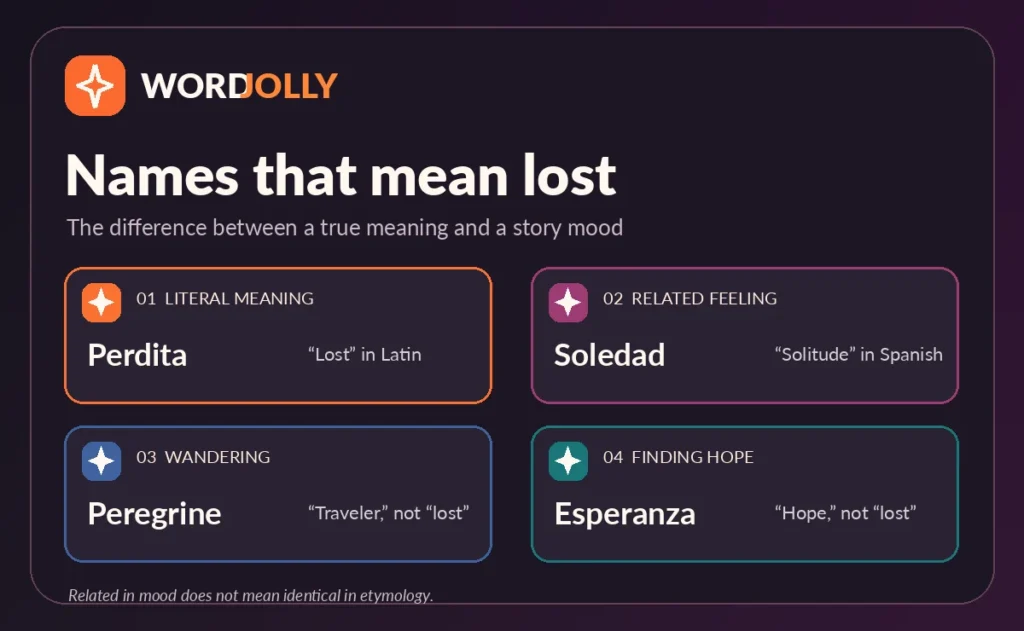
Here is the important distinction: very few established given names literally mean “lost.” One unusually clear example is Perdita, a literary name derived from Latin perditus, meaning “lost.” Many other beautiful names evoke related ideas, such as loneliness, sorrow, travel, misfortune, or renewal, but their literal meanings are different.
Below are 35 carefully labeled options: one direct match, established names with verified related meanings, literary names with stories of separation, hopeful alternatives, and original names for fictional worlds.
Quick answer: If you need the closest documented literal meaning, choose Perdita. For an isolated or wandering character, consider Soledad, Nemo, or Peregrine. For a story about rediscovering hope, try Esperanza or Aurora.
Table of Contents
What Name Literally Means Lost?
1. Perdita — “Lost” (literal meaning)
Origin: Literary Latin | Traditional use: Feminine literary name
Perdita comes from Latin perditus, meaning “lost.” William Shakespeare used the name for the abandoned princess in The Winter’s Tale. She is raised by a shepherd’s family before her true identity is discovered. That story gives the name both sadness and a possibility of reunion.
Perdita is the strongest name on this page for someone searching for a verified name that means lost. It isn’t a traditional name meaning “lonely” or “wanderer.” Its connection is direct.
Sources: Behind the Name: Perdita and the Folger Shakespeare Library synopsis of The Winter’s Tale.
8 Real Names Connected to Sorrow, Solitude and Wandering
The next eight names do not literally mean lost. They are established personal or literary names whose documented meanings may suit a character struggling with separation, grief, or a journey.
2. Soledad — “Solitude”
A Spanish feminine name meaning “solitude.” It suits a quiet, self-reliant character who feels alone, though solitude isn’t the same as being physically lost. Source.
3. Mallory — “Unfortunate”
An English given name from a surname ultimately connected to an Old French word meaning “unfortunate.” It offers a tragic or unlucky mood without suggesting someone cannot find their way. Source.
4. Desdemona — “Ill-fated”
A literary name derived from a Greek word meaning “ill-fated.” Familiar from Shakespeare’s Othello, it has a dramatic, melancholy sound suitable for fiction. Source.
5. Dolores — “Sorrows”
A Spanish name meaning “sorrows,” associated with a traditional Marian title. It expresses grief or loss emotionally, but doesn’t translate to “lost.” Source.
6. Mara — “Bitter” in its Biblical Hebrew form
In the biblical tradition, Naomi calls herself Mara, meaning “bitter,” after family losses. Other languages and traditions have distinct names spelled Mara, so don’t assume every Mara has this etymology. Source.
7. Nemo — “Nobody”
A Latin word meaning “nobody,” used as a literary name by Jules Verne. Nemo suits a character who feels anonymous or disconnected, but it is not a literal translation of “lost.” Source.
8. Peregrine — “Traveler”
From Latin peregrinus, meaning “traveler.” Peregrine is a rare English given name. It is especially good for a wanderer or someone searching for home, not necessarily a person who is lost. Source.
9. Pellegrino — “Pilgrim / Traveler”
An established Italian masculine form related to Peregrinus. It evokes pilgrimage and travel, so it’s a fitting metaphor for searching or wandering, rather than a literal “lost” meaning. Source.
8 Literary and Mythological Names About Being Lost or Found
These names are associated with stories of separation, uncertainty, searching, or reunion. Their historical meanings are not “lost.” Choose them for symbolism rather than a claimed translation.
10. Ariadne — The guide through the labyrinth
In Greek mythology, Ariadne helps Theseus find a way out of the Labyrinth and is later abandoned by him. Her name’s etymology is debated and does not mean lost. She works beautifully as a symbol of guidance, abandonment, and finding an exit. Background.
11. Penelope — Waiting for someone to return
Penelope waits for Odysseus’s homecoming in The Odyssey. Her name is not derived from the English word “lost”; her story represents patience amid absence. Background.
12. Odysseus — The long journey home
Odysseus spends years struggling to return to Ithaca. His name’s original meaning is uncertain, so “lost” is not a verified translation. It is a strong symbolic choice for a traveler trying to get back. Background.
13. Orpheus — Searching for a lost love
Orpheus is remembered in Greek myth for descending to the underworld in an effort to bring back Eurydice. He represents grief and the refusal to give up on someone lost, not a name that literally means loss.
14. Eurydice — The beloved who is lost
Eurydice is central to the Orpheus story. Her name is connected to Greek mythology, and her narrative role, rather than her word meaning, makes her relevant to a story about loss.
15. Dante — Finding the path again
The traveler in Dante Alighieri’s Divine Comedy begins in a dark wood after straying from the right path. Dante is an established name with a separate origin, but this literary association is powerful for a character facing confusion and seeking direction.
16. Alice — Lost in a strange world
Alice’s adventures in Wonderland are an appealing inspiration for a curious character in an unfamiliar place. Her given name has its own history and does not literally mean lost.
17. Dorothy — The search for home
Dorothy’s journey through Oz makes her a classic symbol of wanting to return home. The connection here is storytelling, not the etymology of Dorothy.
8 Beautiful Names for Finding Hope After Feeling Lost
If your story is about recovery rather than despair, these established names can express a new beginning, light, or hope. None is a literal translation of “lost.”
18. Hope — “Hope”
An English virtue name for optimism and trust in a better outcome. It is short, clear, and especially fitting for a character rebuilding their life. Source.
19. Esperanza — “Hope”
A Spanish feminine name connected to Latin spero, “to hope.” It suits a character who discovers purpose after a period of uncertainty. Source.
20. Nadia — Associated with “Hope” in Slavic usage
A well-established feminine name used in several languages, with a Slavic name family linked to hope. Its meaning can depend on cultural context; it does not mean “lost.” Source.
21. Aurora — “Dawn”
From Latin for “dawn.” A beautiful option for renewal, light after darkness, or the beginning of a different path. Source.
22. Zora — “Dawn”
Used in several Slavic languages, Zora means dawn. Its short, lyrical sound makes it memorable for a hopeful protagonist. Source.
23. Anastasia — Associated with “Resurrection”
From a Greek name family connected with resurrection. It provides a powerful metaphor for renewal, though it does not mean “found.” Source.
24. Renée — “Reborn”
A French feminine form of René, from Latin renatus, “reborn.” It can symbolize a second chance or someone building a new identity. Source.
25. Lucia — Associated with “Light”
A feminine name related to Latin Lucius and the root for light. It works beautifully in a narrative where a character discovers clarity after confusion. Source.
10 Original Fantasy Names for Lost Souls and Wanderers
The following are invented English-inspired combinations, not established historical names or verified translations. They are designed for fiction, fantasy maps, writing projects, and usernames.
- Mistwander — A traveler who follows fog-covered trails.
- Hollowpath — A secret road between forgotten places.
- Wandershade — A quiet figure who moves unnoticed.
- Emberfall — A last spark after something precious is gone.
- Northless — Someone whose internal compass has stopped working.
- Wayfarer Ash — A wandering character beginning again after loss.
- Fading Compass — A poetic alias for uncertainty and searching.
- Dusktrail — A mysterious path visible only at twilight.
- Hidden Harbor — A safe place found after a difficult journey.
- Homeward Star — A hopeful symbol guiding someone back.
For a realistic human character, established names such as Perdita, Mallory, or Peregrine are usually more natural than these inventions. For a fantasy location, ship, or online identity, the invented combinations can be more expressive.
How to Choose a Name About Being Lost
Decide whether you need a literal meaning
If a reader must look up the name and find the word “lost”, use Perdita. If you simply want the atmosphere of loneliness or wandering, Soledad, Nemo, and Peregrine open up more options.
Match the name to the story arc
A tragic character could suit Desdemona or Dolores. A traveler might be Peregrine. Someone moving toward a brighter chapter might be Aurora or Esperanza. The right choice often depends on where the character ends up, not just where the story begins.
Check origin, language and usage
Some names have more than one linguistic history. Look for a clear source, check the original language, and avoid copying unsourced meanings from long name lists. Being associated with a story about loss is different from literally meaning lost.
Think about real-world sensitivity
If naming a real child, consider pronunciation, family significance, culture, and how the meaning might feel to the person carrying it. A melancholy meaning can be moving in fiction but may not be the first quality everyone wants in a personal name.
Frequently Asked Questions About Names That Mean Lost
What girl name literally means lost?
Perdita is a well-documented literary feminine name based on a Latin word meaning “lost.” Shakespeare used it in The Winter’s Tale.
Is there a boy name that means lost?
We did not find a comparably well-established masculine given name whose meaning can confidently be given as the direct translation “lost.” Peregrine means “traveler,” and Nemo means “nobody.” They’re related in mood, not literal meaning.
Does Mallory mean lost?
No. Mallory comes from a surname connected to an Old French word meaning “unfortunate.” It is a legitimate related option for misfortune but not a direct synonym of lost.
Does Soledad mean lost or lonely?
Soledad literally means “solitude” in Spanish. It is often emotionally relevant to loneliness, but it does not translate to lost.
Does Nemo mean lost?
No. Nemo means “nobody” in Latin. It can make a strong fictional name for someone who feels forgotten or anonymous.
Which name is best for a character who finds their way home?
Perdita is a compelling option because her story ultimately involves rediscovery. Ariadne represents guidance through confusion, while Aurora and Esperanza evoke a brighter future.
Final Thoughts
When looking for names that mean lost, accuracy makes the choice more meaningful. Perdita is the clearest literal match. Names such as Soledad, Mallory, Nemo, and Peregrine offer related emotional themes, while Hope, Esperanza, and Aurora can represent the journey back toward light.
Whether you’re naming a fictional traveler, searching for a poetic name, or simply exploring language, let the real meaning guide your choice, then let imagination give it a story.
Explore more language discoveries in WordJolly’s Words & Meanings section and browse WordJolly for creative naming inspiration.